
Ethidium Bromide as a Cooperative Effector of DNA Structure
Introduction
DNA structure is not static. Under specific physicochemical conditions, DNA molecules can undergo structural transitions that modify their conformation, stability, and biological function. One of the compounds widely used to study DNA structure is ethidium bromide (EtBr), a fluorescent intercalating agent that binds between DNA base pairs.
Ethidium bromide has played a major role in molecular biology, particularly in DNA visualization during electrophoresis and in studies of DNA topology and conformational transitions. Research has shown that ethidium bromide can act as a cooperative effector, meaning that its binding can induce structural changes in DNA in a coordinated and concentration-dependent manner.
This article explains the mechanism of ethidium bromide interaction with DNA, its cooperative binding behavior, and its relevance for DNA structural studies.
Structure and Properties of Ethidium Bromide
Ethidium bromide is a planar aromatic molecule capable of inserting itself between adjacent base pairs of double-stranded DNA. This process is known as DNA intercalation.
Key characteristics of ethidium bromide include:
- Strong DNA intercalating capability
- High fluorescence when bound to nucleic acids
- Ability to alter DNA helical structure
- Widely used in molecular biology laboratories
When free in solution, ethidium bromide exhibits relatively low fluorescence. However, when intercalated into DNA, its fluorescence intensity increases significantly. This property makes it a powerful tool for DNA detection and quantification.
Mechanism of Ethidium Bromide Intercalation
Ethidium bromide binds to DNA through intercalation between stacked base pairs.
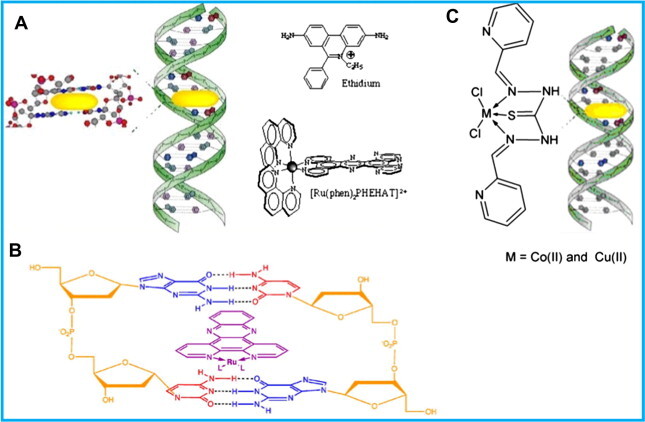
During this process:
- The planar aromatic ring of ethidium bromide slides between adjacent base pairs.
- The DNA helix slightly unwinds.
- The distance between base pairs increases.
These structural modifications lead to:
- Helical unwinding
- DNA elongation
- Changes in DNA supercoiling
Because of these effects, ethidium bromide has been extensively used to investigate DNA topology and conformational changes.
Cooperative Binding Behavior
One of the most significant findings from studies on ethidium bromide–DNA interactions is the cooperative nature of its binding.
In cooperative binding systems:
- The binding of one molecule facilitates the binding of additional molecules nearby.
- Structural changes induced by initial binding events increase the probability of further interactions.
For ethidium bromide:
- Initial intercalation slightly alters DNA structure.
- These local conformational changes promote additional ethidium bromide binding along the DNA molecule.
- As the concentration increases, this can lead to large-scale structural transitions in the DNA helix.
This phenomenon explains why DNA conformational changes can occur abruptly rather than gradually.
Ethidium Bromide and DNA Structural Transitions
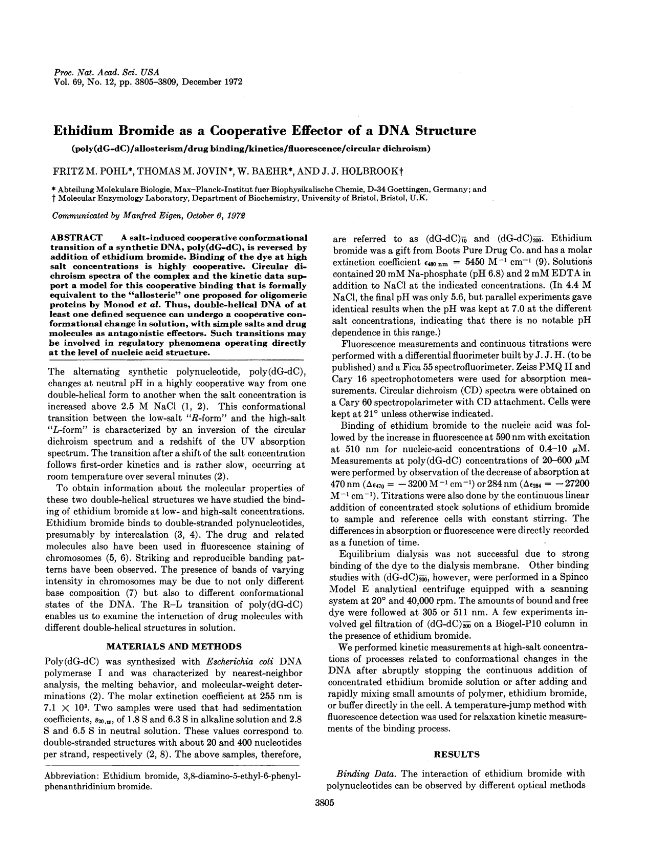
DNA molecules can adopt multiple conformational states depending on environmental conditions such as:
- Ionic strength
- Temperature
- pH
- Binding molecules
Ethidium bromide acts as a chemical effector capable of influencing these structural states.
Research has demonstrated that the presence of ethidium bromide can induce transitions between different DNA conformations, including changes in DNA supercoiling and helix stability.
These structural transitions are particularly important for understanding:
- DNA replication mechanisms
- DNA transcription processes
- Chromosomal organization
- DNA-protein interactions
Applications in Molecular Biology
Due to its unique interaction with nucleic acids, ethidium bromide has become an essential tool in molecular biology.
DNA Visualization in Gel Electrophoresis
Ethidium bromide is widely used for staining DNA in agarose gel electrophoresis. After electrophoretic separation:
- DNA fragments bind ethidium bromide.
- The DNA bands fluoresce under ultraviolet (UV) light.
- Researchers can easily visualize and analyze DNA fragments.
This method is commonly applied in:
- PCR product verification
- DNA fragment analysis
- Molecular cloning workflows
DNA Topology Studies
Ethidium bromide has also been used to study:
By modifying the degree of DNA intercalation, researchers can analyze how DNA structure responds to chemical and physical perturbations.
Biophysical Studies of DNA
In biophysical research, ethidium bromide serves as a molecular probe for investigating DNA conformational properties.
It helps scientists examine:
- DNA helix flexibility
- cooperative binding effects
- nucleic acid stability
- structural transitions within DNA molecules
Safety Considerations

Although ethidium bromide is extremely useful in molecular biology laboratories, it must be handled carefully.
Important safety precautions include:
- Using protective gloves and laboratory coats
- Avoiding skin contact
- Handling solutions in designated laboratory areas
- Proper waste disposal according to laboratory safety regulations
Ethidium bromide is considered a mutagenic compound, and therefore strict laboratory safety procedures must be followed.
Conclusion
Ethidium bromide has significantly contributed to the understanding of DNA structure and molecular interactions. Its ability to intercalate between DNA base pairs and induce cooperative structural changes makes it a valuable tool for studying nucleic acid behavior.
Beyond its role in DNA staining, ethidium bromide has helped researchers explore DNA topology, structural transitions, and cooperative binding mechanisms. These insights continue to support advances in molecular biology, genetics, and biochemical research.
Despite the availability of alternative fluorescent dyes, ethidium bromide remains a foundational reagent in molecular biology laboratories due to its reliability and effectiveness in nucleic acid detection and structural studies.
Recent Posts
-
Histology Without Formalin
Histology Without Formalin: Challenges, Alternatives and Practical Considerations Introduction Tiss …25th Mar 2026 -
Ethidium Bromide as a Cooperative Effector of DNA Structure
Introduction DNA structure is not static. Under specific physicochemical conditions, DNA molecules c …25th Mar 2026 -
Electrophoresis Techniques in Molecular Biology
Electrophoresis is one of the most important analytical techniques used in molecular biology, bioche …25th Mar 2026