
Reading: Enzymes
Enzymes: Structure, Function, Mechanisms and Biological Applications
Understanding Enzymes and Their Role in Biological Reactions
Enzymes are biological catalysts, predominantly composed of proteins, that play an essential role in regulating and accelerating biochemical reactions in living organisms. They are involved in virtually every biological process, including digestion, metabolism, cellular respiration, DNA replication, protein synthesis, energy production, and cellular signaling.
Enzymes have the ability to recognize and bind specific molecules known as substrates through specialized regions called active sites. Once a substrate binds to the enzyme, the enzyme facilitates a chemical transformation that converts the substrate into a different molecule, known as the product of the reaction.
Substrates interact with enzymes in a manner similar to the way ligands bind to other proteins. However, enzyme-substrate interactions are particularly important because binding is followed by a chemical reaction that modifies the substrate and generates one or more products.
By lowering the activation energy required for a reaction to occur, enzymes allow biochemical processes to proceed much faster under physiological conditions. This catalytic activity is essential for maintaining normal cellular functions and supporting the complex metabolic networks that sustain life.
Importantly, enzymes accelerate reactions without being permanently consumed or altered by the overall reaction. Once the products have been released, the enzyme can participate in another catalytic cycle and interact with additional substrate molecules.
The Active Site: Where Enzyme Catalysis Takes Place
The active site is a specialized region of an enzyme where substrate recognition, binding, and chemical transformation take place. It is formed by specific amino acid residues that create a three-dimensional environment adapted to interact with particular substrates.
Although the amino acids forming the active site may be located at different positions within the enzyme's primary amino acid sequence, protein folding brings them together to create the functional catalytic region.
The substrate binds to the enzyme through interactions with amino acids located within the binding site. These interactions may include hydrogen bonds, ionic interactions, hydrophobic interactions, and van der Waals forces.
The active site generally performs two interconnected functions:
1. Substrate Recognition and Binding
Certain amino acid residues are responsible for recognizing the chemical structure, size, and functional groups of the substrate. These interactions help position the substrate correctly within the active site and contribute to enzyme specificity.
The ability to recognize particular substrates allows enzymes to distinguish between different molecules and catalyze specific biochemical reactions.
2. Catalytic Activity
Other amino acid residues participate directly in facilitating the chemical transformation of the substrate. They may act as proton donors or acceptors, stabilize charged intermediates, facilitate bond formation or cleavage, and contribute to the stabilization of the transition state.
In many enzymes, the amino acids responsible for substrate binding and those involved in catalysis overlap, allowing the active site to coordinate molecular recognition and chemical transformation efficiently.
The precise arrangement of these amino acid residues is essential for enzyme activity. Even small changes in the active site's structure can influence substrate binding, catalytic efficiency, and reaction specificity.

Enzyme-Substrate Interactions and the Induced-Fit Model
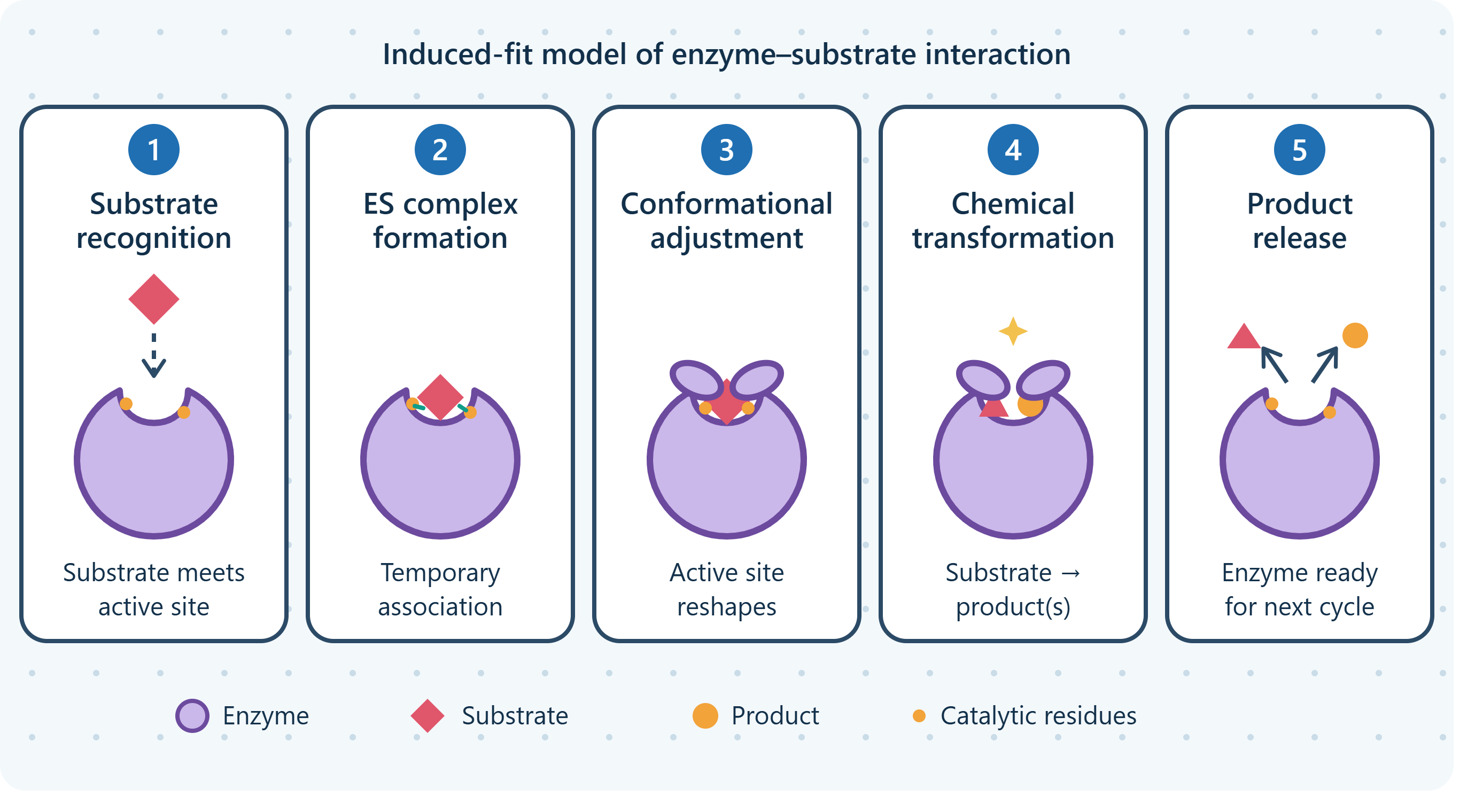
The interaction between an enzyme and its substrate is a fundamental step in enzymatic catalysis. When a substrate approaches an enzyme, it interacts with specific amino acid residues within the active site, resulting in the formation of an enzyme-substrate complex.
One important model used to explain this interaction is the induced-fit model.
According to this model, substrate binding can trigger conformational changes in the enzyme's structure. Rather than functioning as a completely rigid structure, the enzyme adjusts its conformation to accommodate the substrate more effectively.
These structural changes help position important catalytic amino acid residues in the appropriate orientation, creating an environment that facilitates the chemical reaction.
The induced-fit mechanism contributes to substrate recognition, catalytic efficiency, and the stabilization of reaction intermediates.
The general sequence of enzymatic activity involves several stages:
-
Substrate recognition: The substrate approaches the enzyme and interacts with complementary regions of its active site.
-
Enzyme-substrate complex formation: Molecular interactions establish a temporary association between the enzyme and the substrate.
-
Conformational adjustment: The enzyme may undergo structural changes that improve substrate positioning and optimize catalytic conditions.
-
Chemical transformation: The enzyme facilitates the conversion of the substrate into one or more products.
-
Product release: The reaction products leave the active site, allowing the enzyme to participate in another catalytic cycle.
This process illustrates how enzymes combine molecular recognition with catalytic activity to accelerate biochemical reactions.
Enzymes as Biological Catalysts
Enzymes are classified as catalysts because they increase the rate of chemical reactions without being permanently consumed during the process.
To understand their catalytic function, it is important to consider the concept of activation energy. Activation energy is the minimum energy required for reactants to reach the transition state and undergo a chemical transformation.
Many biochemical reactions would proceed too slowly to support normal cellular activity without enzymatic catalysis. Enzymes accelerate these reactions by providing an alternative reaction pathway with a lower activation energy.
They achieve this through several mechanisms, including:
-
Bringing reacting molecules into close proximity.
-
Correctly orienting substrates for chemical reactions.
-
Stabilizing transition states and reaction intermediates.
-
Facilitating proton transfer through acid-base catalysis.
-
Participating in temporary covalent interactions with substrates.
-
Creating a favorable chemical microenvironment within the active site.
By coordinating these mechanisms, enzymes can significantly accelerate reactions that would otherwise occur too slowly under physiological conditions.
Although enzymes participate directly in catalytic processes, they are regenerated at the end of the reaction and can continue performing their biological functions.
Enzyme Specificity: Why Enzymes Recognize Particular Substrates
Enzymes are generally highly specific for their substrates. Their specificity depends on the three-dimensional structure of the active site and the chemical properties of the amino acid residues involved in substrate recognition.
The shape, charge distribution, polarity, and chemical groups present within the active site determine which molecules can interact effectively with an enzyme.
Some enzymes recognize a single substrate or a narrow range of structurally related molecules, whereas others can act on a broader group of substrates sharing similar chemical characteristics.
Enzyme specificity is particularly important because it allows multiple biochemical reactions to occur simultaneously within cells without widespread interference between unrelated metabolic pathways.
For example, lactase and pepsin both catalyze hydrolysis reactions, meaning that they facilitate the breaking of chemical bonds through the addition of water. However, they act on completely different types of substrates.
Lactase specifically catalyzes the hydrolysis of lactose, a sugar naturally present in mammalian milk. Pepsin, on the other hand, is involved in protein digestion and catalyzes the breakdown of peptide bonds within proteins.
These examples demonstrate how enzymes can catalyze the same general type of chemical reaction while maintaining different substrate specificities.
Examples of Enzymes and Their Biological Functions
Enzymes are involved in a wide variety of physiological and biochemical processes. Their names often provide an indication of their catalytic functions, although this is not always the case.
Many enzyme names end with the suffix -ase, which is commonly associated with the substrate on which the enzyme acts or the type of reaction it catalyzes.
Lactase: Enzyme Involved in Lactose Digestion
Lactase is a digestive enzyme responsible for breaking down lactose, the main sugar found in mammalian milk.
It catalyzes the hydrolysis of lactose into two simpler monosaccharides: glucose and galactose.
This reaction is important because lactose must be broken down into smaller sugar molecules before it can be efficiently absorbed through the intestinal epithelium.
Lactase is produced primarily by the cells lining the small intestine, where it contributes to normal carbohydrate digestion.
The specificity of lactase is determined by the structural and chemical characteristics of its active site, which allow it to recognize lactose and facilitate the hydrolysis of its glycosidic bond.
Pepsin: Enzyme Involved in Protein Digestion
Pepsin is a digestive enzyme that plays an important role in the breakdown of dietary proteins within the stomach.
Unlike lactase, which acts on a carbohydrate substrate, pepsin specifically catalyzes the hydrolysis of peptide bonds in proteins.
Protein molecules are composed of amino acids connected through peptide bonds. During digestion, pepsin breaks these bonds, producing smaller peptides that can subsequently undergo further enzymatic digestion in the gastrointestinal tract.
Pepsin functions in the acidic environment of the stomach, where its catalytic activity is adapted to the low pH conditions of gastric contents.
Its role illustrates how enzymes can recognize different types of biological molecules and catalyze specific chemical transformations.
Hydrolysis: An Important Type of Enzymatic Reaction
Hydrolysis is a chemical reaction in which a chemical bond is broken through the addition of a water molecule.
The term comes from two Greek-derived components: hydro, meaning water, and lysis, meaning to break.
Hydrolysis reactions are essential in numerous biological processes, particularly digestion, macromolecule degradation, and cellular metabolism.
Enzymes that catalyze hydrolysis reactions are known as hydrolases. They act on different types of chemical bonds, including glycosidic bonds in carbohydrates, peptide bonds in proteins, and ester bonds in lipids.
Examples include:
-
Lactase: Catalyzes the hydrolysis of lactose into glucose and galactose.
-
Pepsin: Catalyzes the hydrolysis of peptide bonds in proteins.
-
Lipases: Catalyze the hydrolysis of ester bonds in triglycerides and other lipids.
-
Proteases: Catalyze the hydrolysis of peptide bonds in proteins and peptides.
-
Amylases: Catalyze the hydrolysis of specific glycosidic bonds in starch and related carbohydrates.
These enzymes demonstrate the diversity of hydrolytic reactions and their importance in the breakdown and processing of biological molecules.
Factors Influencing Enzyme Activity
Enzyme activity depends on several environmental and biochemical factors that influence the enzyme's three-dimensional structure, substrate binding, and catalytic efficiency.
Understanding these factors is essential when studying enzymatic reactions and optimizing experimental conditions in biochemical and molecular biology research.
Temperature: Enzyme activity generally increases with temperature up to an optimal range because molecular movement and reaction rates increase. However, temperatures exceeding the enzyme's stability range may cause structural changes or denaturation, resulting in reduced catalytic activity.
pH: Each enzyme has a characteristic pH range in which it exhibits optimal activity. Changes in pH can modify the ionization state of amino acid residues within the active site and affect substrate binding and catalysis.
Substrate Concentration: Increasing substrate concentration generally increases the reaction rate until the enzyme approaches saturation. At saturation, most active sites are occupied, and the reaction reaches its maximum velocity under the given conditions.
Enzyme Concentration: When sufficient substrate is available, increasing enzyme concentration generally increases the reaction rate because more active sites are available to catalyze the reaction.
Inhibitors and Activators: Certain molecules can reduce or increase enzyme activity by interacting with the enzyme or influencing its catalytic mechanisms. Inhibitors may interfere with substrate binding or catalytic function, whereas activators can enhance enzyme activity under appropriate conditions.
Applications of Enzymes in Life Science Research and Biotechnology
Enzymes are indispensable tools in scientific research and biotechnology because of their catalytic efficiency, molecular specificity, and ability to facilitate complex biochemical transformations.
They are widely used across several research disciplines, including:
Molecular Biology: Restriction enzymes, DNA polymerases, ligases, and reverse transcriptases are essential for DNA manipulation, PCR amplification, cloning, sequencing, and gene expression studies.
Biochemistry: Enzymes are used to investigate metabolic pathways, protein activity, biochemical interactions, and the mechanisms underlying biological reactions.
Cell Biology: Enzymatic assays help researchers investigate cellular metabolism, signaling mechanisms, enzyme regulation, and changes in cellular function.
Pharmaceutical Research: Enzymes are important targets in drug discovery and development. Researchers investigate enzyme inhibitors, enzyme activation, and interactions between candidate compounds and specific catalytic proteins.
Clinical and Diagnostic Research: Enzymatic reactions form the basis of numerous analytical methods used in laboratory testing, biomarker research, and diagnostic assay development.
Industrial Biotechnology: Enzymes are used in food production, fermentation, biotechnology manufacturing, chemical processing, and other applications requiring controlled biological catalysis.
Explore Enzymes for Biochemical and Molecular Biology Applications
From substrate recognition and catalytic mechanisms to metabolic regulation and molecular research, enzymes are fundamental components of biological systems.
Understanding how enzymes interact with their substrates, facilitate chemical transformations, and maintain catalytic activity provides important insights into cellular processes and biochemical pathways.
Whether your research focuses on enzymatic activity, protein function, molecular biology, carbohydrate metabolism, or protein digestion, enzymes offer essential tools for investigating biological reactions and understanding complex molecular mechanisms.
Explore our range of enzyme products and related research reagents to support your biochemical experiments, molecular investigations, and life science research applications.