
Goat Anti-Rabbit IgG
Goat Anti-Rabbit IgG, Affinity Purified (Cat. No. 7455607): A Ready-to-Use Secondary Antibody for Rabbit Primary Detection
Introduction
Rabbit antibodies have become some of the most popular primary antibodies in research. They often show high affinity and strong specificity, and they work well for detecting low-abundance proteins and for difficult targets such as phosphorylated proteins. But a rabbit primary antibody is only half of the detection system. To turn its binding into a visible signal, researchers need a secondary antibody that recognizes it.
Goat Anti-Rabbit IgG, Affinity Purified (Catalog No. 7455607) from Lampire Biological Laboratories fills that role. It comes as 1 gram of antibody in 100 mL, at a concentration of 10 mg/mL. This article covers what the product is, what the label tells us, how it can be used, and how to store and handle it.
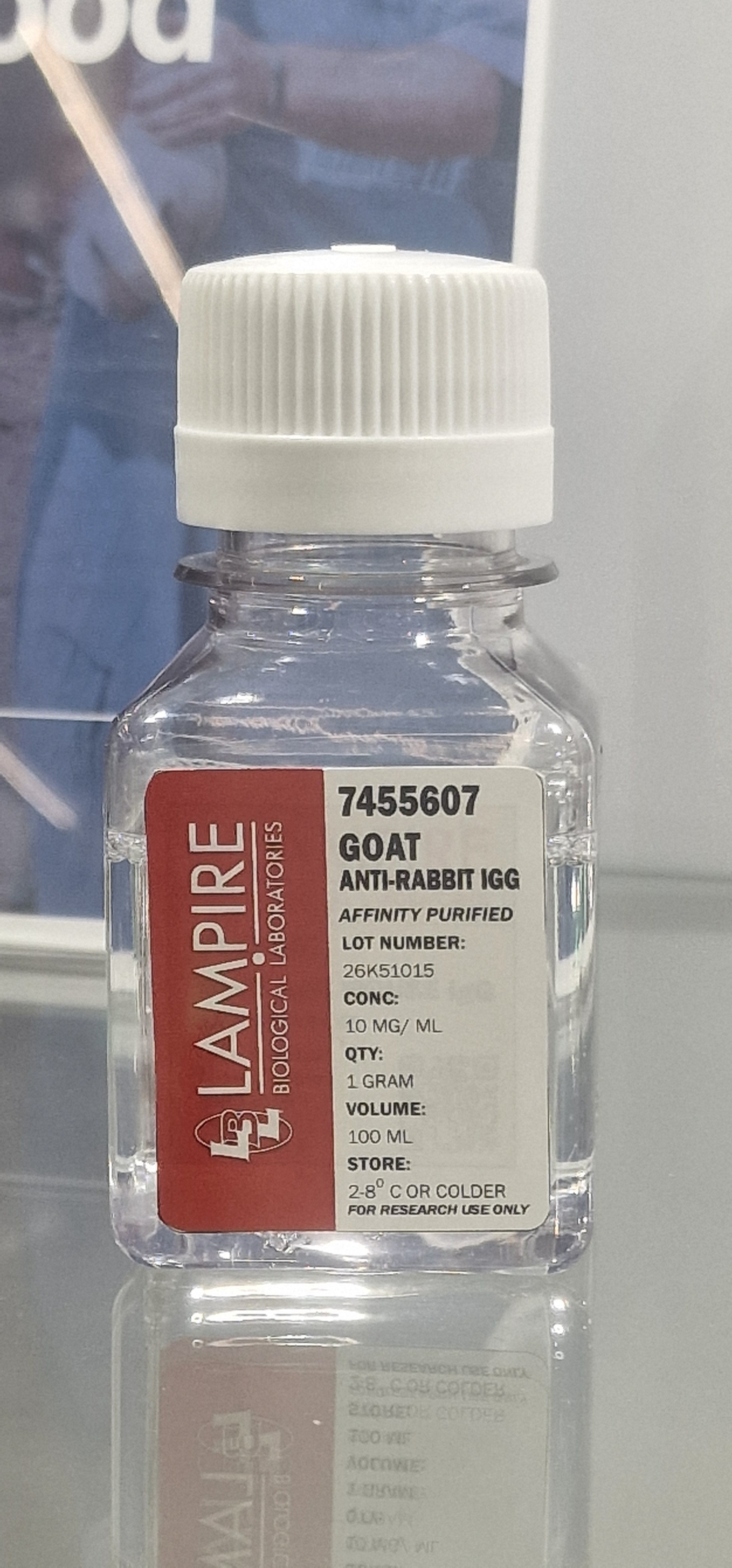
What Is a Goat Anti-Rabbit IgG?
The name breaks down into three parts:
- Goat: the host animal in which the antibody was produced
- Anti-Rabbit IgG: the antibody recognizes rabbit immunoglobulin G, the main antibody class in rabbit serum and the class used in most rabbit primary antibodies
- Affinity purified: the antibody was isolated by a method that selects the antibodies that bind the target
In practice, this reagent can detect any rabbit primary antibody. If a researcher uses a rabbit antibody to find a protein, a goat anti-rabbit IgG reveals where that primary antibody has bound.
Product Overview
| Specification | Detail |
|---|---|
| Catalog Number | 7455607 |
| Product Name | Goat Anti-Rabbit IgG |
| Purification | Affinity purified |
| Lot Number | 26K51015 |
| Concentration | 10 mg/mL |
| Quantity | 1 gram |
| Volume | 100 mL |
| Storage | 2–8 °C or colder |
| Intended Use | For research use only |
The numbers are consistent: 10 mg/mL × 100 mL = 1,000 mg, or 1 gram. This is a mid-size format, larger than the small vials sold for individual experiments and smaller than a bulk liter.
What Does “Affinity Purified” Mean?
Affinity purification uses a matrix to which the target is attached. When the crude antibody preparation passes through, the antibodies that recognize the target stick to the matrix while unwanted proteins wash away. The bound antibodies are then released, giving a preparation enriched in the desired specificity.
Compared with less purified preparations, affinity-purified antibodies generally offer:
- Higher specificity for the intended target
- Lower background in sensitive assays
- Better lot-to-lot consistency, which supports reproducibility
For details such as cross-reactivity with other species, please refer to the product’s technical documentation.
Why Use a Secondary Antibody?
Compared with labeling every primary antibody directly, a secondary antibody offers several advantages:
- Signal amplification: several secondary antibodies can bind a single primary antibody, which strengthens the signal
- Flexibility: one secondary antibody works with many different rabbit primary antibodies
- Cost savings: you label or conjugate one reagent instead of many
- Convenience: a standard detection system can be reused across projects
Common Applications
Conjugate Preparation
The unconjugated, purified antibody can be coupled to enzymes such as horseradish peroxidase (HRP) or alkaline phosphatase, to fluorescent dyes, to biotin, or to nanoparticles. At 1 gram, this format suits groups that prepare their own labeled reagents.
ELISA
In an indirect ELISA, anti-rabbit IgG detects rabbit antibodies bound to the antigen-coated plate. It is also used to measure antibody titers in immunized rabbits and to detect rabbit antibodies in sandwich formats.
Western Blotting
After a rabbit primary antibody binds the protein of interest on the membrane, a labeled anti-rabbit IgG reveals the band.
Immunofluorescence and Immunohistochemistry
Labeled anti-rabbit IgG is widely used to visualize proteins in cells and tissue sections.
Flow Cytometry
Secondary antibodies detect unlabeled rabbit primary antibodies on the surface of cells or inside them.
Immunoprecipitation and Capture Assays
Anti-rabbit IgG can capture rabbit antibodies onto beads or plates, which is useful for purification and assay design.
For each application, users must determine the optimal working concentration by titration.
Why Choose a 100 mL, 1 g Format?
This format is practical for:
- Assay and diagnostic developers who need enough material to optimize and validate methods
- Research groups with regular, ongoing use of rabbit primary antibodies
- Core facilities serving several projects
- Small-scale reagent producers who prepare labeled conjugates
Using a single lot over a long period also reduces batch-to-batch variability.
Handling and Storage
- Store at 2–8 °C or colder, as stated on the label.
- Aliquot for long-term storage. Dividing the contents into working volumes avoids repeated handling of the main stock. If you plan to freeze aliquots, check the product documentation first and avoid repeated freeze-thaw cycles.
- Use aseptic technique when withdrawing material, to limit contamination.
- Mix gently. Avoid vigorous shaking or vortexing, which creates foam and can denature proteins.
- Record the lot number (26K51015) in your notebook for traceability.
- Wear standard protective equipment (gloves, lab coat, eye protection) and follow your institution’s biosafety guidelines.
The label specifies “For Research Use Only”, so the product is not intended for diagnostic or therapeutic use in humans or animals.
From Goat to Bottle: How Is This Antibody Made?
Secondary antibodies like this one come from animals. The general process works as follows:
- Immunization: goats are immunized with purified rabbit IgG, which prompts their immune systems to produce antibodies against it.
- Collection: blood is collected and the serum is separated.
- Purification: the antibodies are purified, and affinity purification isolates those that specifically recognize rabbit IgG.
- Formulation and packaging: the purified antibody is brought to a defined concentration, here 10 mg/mL, and bottled.
Goats are a popular host for secondary antibodies because they are large animals that provide substantial volumes of serum and produce strong antibody responses. The label does not describe animal care practices, so if you want to address animal welfare in your blog, confirm the details with Lampire directly.
About Lampire Biological Laboratories
Lampire Biological Laboratories supplies biological products to the research, diagnostic, and bioprocessing communities. Its portfolio includes antibodies, sera, and other animal-derived materials, as well as custom preparations for specialized projects.
Frequently Asked Questions
Is this antibody conjugated?
The label does not indicate any conjugate, so it appears to be an unconjugated, purified antibody. Confirm with the supplier.
Which applications has it been validated for?
The label does not list validated applications. Check the technical documentation and validate the antibody in your own system.
Does it cross-react with other species?
The label gives no cross-reactivity data. If your samples come from several species, ask the supplier.
What buffer is it supplied in?
The label does not say. Request this information if it matters for conjugation or your assay.
Can I order a different quantity?
Contact Lampire to ask about other sizes, including the larger bulk formats, and custom options.
Conclusion
Goat Anti-Rabbit IgG, Affinity Purified (Cat. No. 7455607) is a practical secondary antibody for any workflow that uses rabbit primary antibodies. With 1 gram of purified antibody at 10 mg/mL in a 100 mL bottle, it suits assay development, conjugate preparation, and routine immunodetection, and its clear labeling of lot number and storage conditions supports traceability.