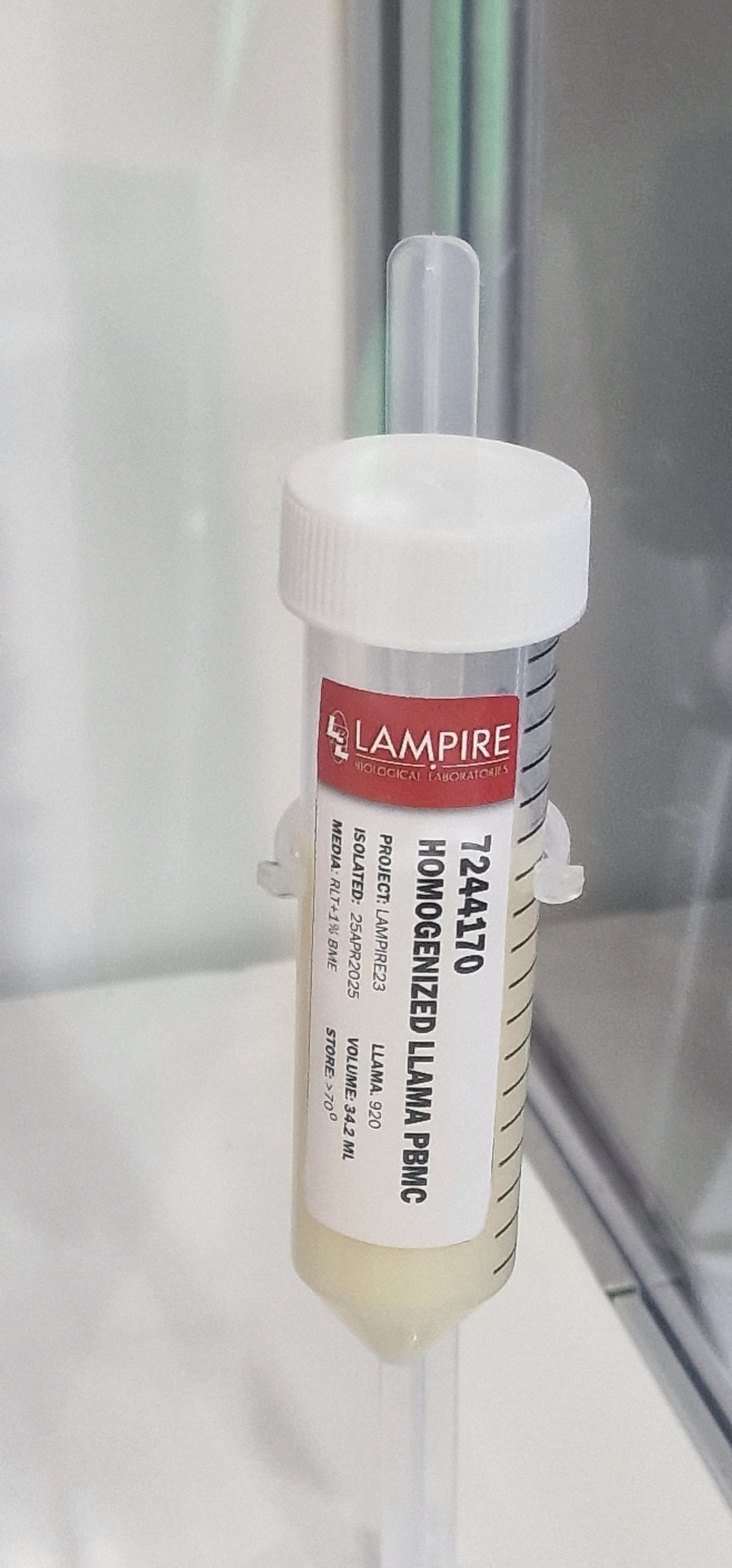
Homogenized Llama PBMC
Homogenized Llama PBMC (Cat. No. 7244170): A Ready-to-Use Lysate for Camelid Immunology and Nanobody Research
Introduction
Few animals have reshaped modern biotechnology the way camelids have. Llamas, alpacas, and camels produce a remarkable class of antibodies that are unlike those of most other mammals, and that discovery has opened new directions in diagnostics, therapeutics, and structural biology. But working with camelid material is not easy. Access to animals is limited, sample collection requires specialized expertise, and preserving nucleic acid quality from the moment of collection is critical.
That is where Homogenized Llama PBMC (Catalog No. 7244170) from Lampire Biological Laboratories comes in. This product provides llama peripheral blood mononuclear cells that have already been isolated, lysed, and stabilized in a lysis buffer, so they are ready for downstream molecular workflows.
In this article, we look at what this product is, how it is prepared, why its formulation matters, and how researchers can use it.
What Are PBMCs?
Peripheral blood mononuclear cells (PBMCs) are blood cells with a single, round nucleus. They include:
- Lymphocytes: T cells, B cells, and NK cells
- Monocytes: precursors of macrophages and dendritic cells
PBMCs are a cornerstone of immunology research because they contain the cells responsible for adaptive and innate immune responses. In particular, B cells are the source of antibody-encoding genes, which makes PBMCs an essential starting material for antibody discovery and immune repertoire studies.
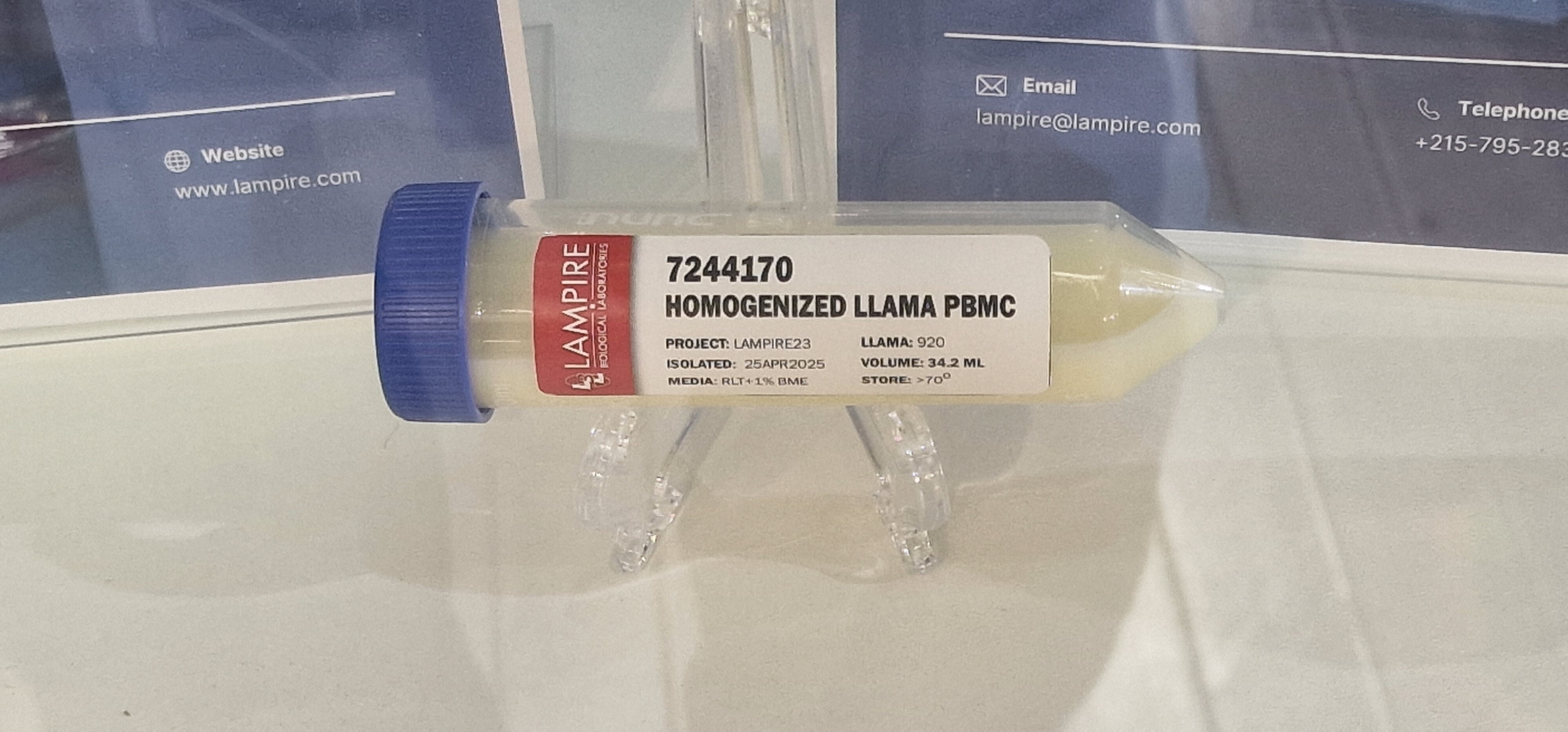
Product Overview
Catalog number 7244170 is a homogenized lysate of llama PBMCs. Rather than shipping live cells, which require careful handling, cryopreservation, and viability checks, this product delivers the cellular material already disrupted and stabilized.
| Specification | Detail |
|---|---|
| Catalog Number | 7244170 |
| Product Name | Homogenized Llama PBMC |
| Species | Llama |
| Animal ID | 920 |
| Project Code | LAMPIRE23 |
| Isolation Date | April 25, 2025 |
| Media | RLT buffer + 1% β-mercaptoethanol (BME) |
| Volume | 34.2 mL |
| Storage | Ultra-low temperature (please confirm on the product label) |
Every tube is labeled with its catalog number, project code, animal identifier, isolation date, media, and volume. This supports the traceability that research teams need for reproducible work.
Understanding the Formulation: RLT Buffer and β-Mercaptoethanol
The most important technical detail on the label is the medium: RLT buffer supplemented with 1% β-mercaptoethanol (BME).
RLT Buffer
RLT is a guanidine-based lysis buffer widely used in RNA purification. Guanidine salts are strong chaotropic agents. They disrupt cell membranes, denature proteins, and help release nucleic acids while keeping them protected.
β-Mercaptoethanol
BME is a reducing agent. Added to the lysis buffer, it:
- Breaks disulfide bonds in proteins, including ribonucleases (RNases)
- Enhances the inactivation of RNases, which are among the biggest threats to RNA integrity
- Improves lysis efficiency and sample stability
Why This Matters
RNA is fragile. Once cells are broken open, endogenous RNases can degrade RNA within minutes. By lysing the cells at the point of preparation, this product locks the sample in a protective environment. The result is material that is much easier to store, ship, and process than live cells or fresh blood.
Key Advantages for Researchers
1. No cell culture or live-cell handling required. The cells are already lysed, so there is no need for biosafety procedures tied to live cells or for viability assessment.
2. Protected RNA. The guanidine and BME combination preserves RNA quality from the moment of preparation until you are ready to extract.
3. Convenient volume. At 34.2 mL, one tube can supply material for multiple extractions. Aliquoting lets you spread the sample over several experiments.
4. Full traceability. The label shows the animal ID, project, and isolation date, so you can document the origin of your starting material.
5. Access to hard-to-source species. Not every laboratory has access to llamas or the infrastructure to collect and process samples. A ready-made lysate removes that barrier.
Applications
Nanobody (VHH) Discovery
Camelids produce heavy-chain-only antibodies (HCAbs), which lack the light chains found in conventional antibodies. The antigen-binding fragment of these antibodies, called VHH or nanobody, is small, stable, and highly soluble. Nanobodies are valued for:
- Their small size (roughly 15 kDa), which allows them to reach epitopes that larger antibodies cannot
- Their strong stability under heat and pH stress
- Their ease of production in microbial expression systems
- Their versatility in therapeutics, diagnostics, imaging, and research tools
RNA extracted from llama PBMCs can be reverse-transcribed into cDNA, and VHH sequences can then be amplified by PCR to build libraries for phage display or other selection platforms.
Immune Repertoire Sequencing
High-throughput sequencing of antibody genes gives a detailed view of the immune repertoire. PBMC-derived RNA is a standard input for these workflows. It can be used to study clonal diversity, gene usage, and the features of camelid antibody genes.
Gene Expression Analysis
Researchers can use extracted RNA for:
- RT-qPCR
- RNA sequencing
- Transcriptome profiling of llama immune cells
Comparative Immunology and Genomics
Llama samples are valuable for studying how immune systems differ across species. They are especially useful in evolutionary immunology and in work on camelid-specific genes.
Assay and Method Development
Because the material is stable and well characterized, it is also useful for validating extraction protocols, optimizing primers, and testing PCR or sequencing workflows before moving to precious or limited samples.
Suggested Workflow
A typical workflow using this product might look like this:
- Thaw the lysate on ice or according to your laboratory protocol.
- Aliquot the required volume into RNase-free tubes.
- Extract RNA using a compatible method, such as a silica-column kit designed for guanidine-based lysates, or phenol-based approaches.
- Assess quality by spectrophotometry and, ideally, a fragment analyzer or similar system.
- Synthesize cDNA with oligo(dT) or gene-specific primers.
- Amplify your targets, such as VHH regions, by PCR.
- Clone, sequence, or build libraries according to your application.
Always follow the protocol recommended by your extraction kit manufacturer.
Handling, Storage, and Safety
- Storage: Keep the product at ultra-low temperature as indicated on the label.
- Freeze-thaw cycles: Avoid repeated freezing and thawing. Aliquot on first use.
- Safety: The lysate contains guanidine salts and β-mercaptoethanol. BME has a strong odor and is hazardous. Work in a well-ventilated area or fume hood, and wear gloves, a lab coat, and eye protection.
- Incompatibilities: Do not mix guanidine-containing solutions with bleach or other strong oxidizers.
- Disposal: Dispose of waste according to your institution’s chemical safety regulations.
Quality and Traceability
For regulated or collaborative research, knowing exactly where your material came from is essential. Each tube of Homogenized Llama PBMC carries a unique catalog number, a project code (LAMPIRE23), an animal identifier (Llama 920), and an isolation date (25 April 2025). Documenting these details in your lab notebook or data management system helps ensure that your results can be reproduced and audited.
About Lampire Biological Laboratories
Lampire Biological Laboratories supplies biological products to the research, diagnostic, and bioprocessing communities. Its portfolio includes animal-derived materials such as antibodies, sera, and custom-prepared samples. Researchers rely on Lampire for specialized materials that can be difficult to source elsewhere.
Frequently Asked Questions
Is this product suitable for protein work?
The formulation is designed mainly for nucleic acid extraction. Guanidine and BME are denaturing, so this lysate is not intended for native protein studies.
Can I use it for DNA extraction?
The lysate contains cellular material, so DNA may be recoverable. However, the formulation is optimized for RNA workflows. Check your kit’s compatibility.
How many extractions can I get from one tube?
That depends on your extraction method and the input volume per prep. With 34.2 mL, many users will be able to run multiple extractions.
Is custom preparation available?
Lampire is known for custom biological materials. Contact the company to ask about other volumes, species, or formats.
Conclusion
For researchers working on nanobody discovery, camelid immunology, or comparative gene expression, Homogenized Llama PBMC (Cat. No. 7244170) offers a practical shortcut. The cells arrive already lysed and stabilized in RLT buffer with 1% β-mercaptoethanol, ready for RNA extraction without live-cell handling. With a generous 34.2 mL volume and full labeling for traceability, it is a convenient starting material for a range of molecular biology projects.