
Goat Serum
Goat Serum, Donor, Unfiltered (Cat. No. 7322500): A Versatile Animal-Derived Reagent for Blocking, Assay Development, and Research
Introduction
In many laboratories, goat serum is a shelf staple. It appears in immunohistochemistry blocking buffers, in immunofluorescence protocols, in assay diluents, and in a wide range of immunology workflows. It is a simple reagent with a very practical role: helping researchers get cleaner, more reliable results.
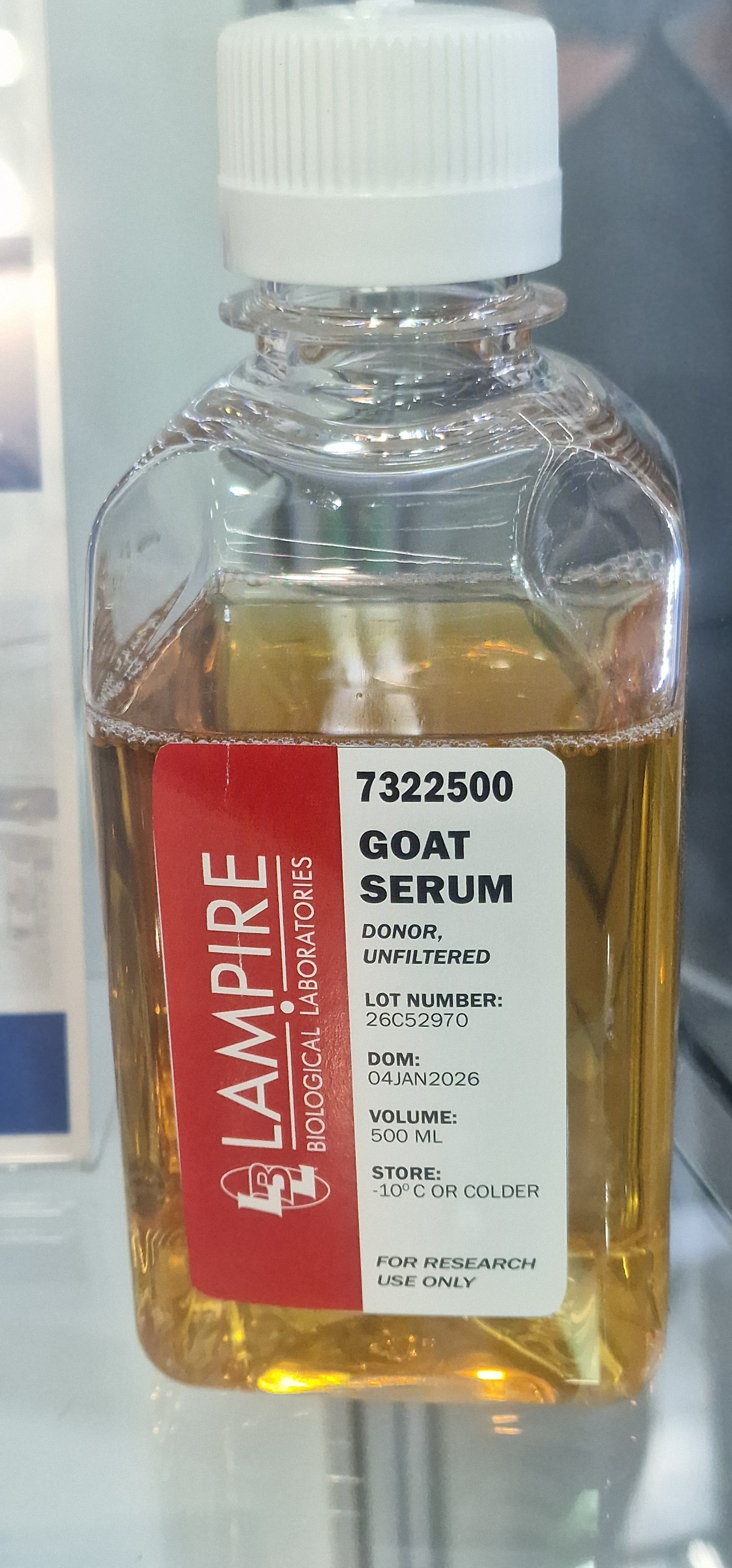
Goat Serum, Donor, Unfiltered (Catalog No. 7322500) from Lampire Biological Laboratories is supplied in a 500 mL bottle and labeled for research use. This article covers what goat serum is, what “donor” and “unfiltered” mean, how it is used, and how to store and handle it.
What Is Serum?
Serum is the clear, straw-colored liquid that remains after blood has clotted and the cells and clotting factors have been removed. It is a complex mixture that contains:
- Proteins, including albumin and globulins
- Antibodies (immunoglobulins)
- Hormones and growth factors
- Electrolytes, lipids, and metabolites
Goat serum is the serum obtained from goats. Its amber color, visible in the bottle, is typical of serum.
Product Overview
| Specification | Detail |
|---|---|
| Catalog Number | 7322500 |
| Product Name | Goat Serum |
| Type | Donor, unfiltered |
| Lot Number | 26C52970 |
| Date of Manufacture (DOM) | January 4, 2026 |
| Volume | 500 mL |
| Storage | −10 °C or colder |
| Intended Use | For research use only |
The label gives the lot number and date of manufacture, which makes the material easy to trace and document.
Understanding “Donor” and “Unfiltered”
Donor Serum
“Donor” generally refers to serum collected from donor animals, as opposed to serum from animals immunized for a specific purpose. For details such as the health status, age, and breed of the animals, consult the product documentation or ask the supplier.
Unfiltered
Unfiltered means the serum has not been passed through a sterilizing filter (typically 0.1 or 0.2 µm). In practice:
- It suits applications where sterility is not required, such as many immunoassay and biochemical uses.
- It allows researchers to apply their own filtration step.
- For cell culture or other sterile work, you will usually need to filter it yourself or choose a filtered product.
Common Applications
Blocking in Immunohistochemistry and Immunofluorescence
This is one of the best-known uses of goat serum. When a secondary antibody is raised in goat, normal goat serum is commonly used at about 5 to 10% in the blocking buffer. The serum proteins occupy non-specific binding sites on the tissue or cells, which reduces background staining. The blocking serum is normally matched to the host species of the secondary antibody, so confirm this for your own protocol.
Western Blotting and ELISA
Goat serum can be used as a blocking agent or as an additive in antibody dilution buffers to limit non-specific binding and lower background signal.

Assay Diluent and Matrix
In assay development, goat serum can serve as a species-matched matrix for diluting samples and standards, or for testing how a biological matrix affects assay performance.
Immunology Research
Serum contains natural antibodies, complement, and other immune components. Researchers use it in studies of innate immunity, antibody responses, and complement activity.
Antibody Production and Purification Workflows
Goat serum is the starting material for many goat-derived antibody preparations. Normal goat serum is also useful as a control, for example in experiments that compare it with immune serum.
Cell Culture Supplementation (with care)
Serum can support some cell types in culture. Because this product is unfiltered, sterile filtration and suitability testing would be needed before any cell work. Always check that the grade fits your application.
Handling and Storage
Good handling protects the quality of your serum.
- Store at −10 °C or colder, as stated on the label.
- Thaw gently, for example overnight in a refrigerator or briefly in a water bath at a moderate temperature. Avoid high heat.
- Aliquot before freezing. With a 500 mL bottle, this step matters. Dividing the serum into smaller working volumes avoids repeated freeze-thaw cycles, which can degrade proteins and reduce performance.
- Mix gently after thawing. Avoid vigorous shaking, which causes foaming.
- Use aseptic technique, especially because the product is not filtered.
- Record the lot number (26C52970) and the manufacturing date (04 JAN 2026) in your notebook.
Safety Considerations
Like any biological material of animal origin, goat serum should be handled with standard laboratory precautions: gloves, lab coat, and eye protection. Follow your institution’s biosafety guidelines and dispose of used material according to local regulations. The label specifies “For Research Use Only,” so the product is not intended for diagnostic or therapeutic use in humans or animals.
From Goat to Bottle: Where Does Serum Come From?
Goat serum is an animal-derived product. It is obtained from blood collected from goats, which is allowed to clot before the serum is separated and bottled. Goats are well suited to this role because they are large animals that can provide substantial volumes of serum, which makes a 500 mL format practical.
Because the material comes from living animals, details such as breed, age, and health status can matter for certain research uses, and animal welfare is an important consideration for any animal-derived reagent. The label does not describe these practices, so if you want to address them in your blog, confirm the details with Lampire directly.
Why Choose a 500 mL Format?
A 500 mL bottle suits:
- Histology and imaging laboratories that use blocking serum routinely
- Core facilities serving many users
- Assay and diagnostic developers who need a consistent lot
- Research groups with long-running studies, where using the same lot limits variability
About Lampire Biological Laboratories
Lampire Biological Laboratories supplies biological products to the research, diagnostic, and bioprocessing communities. Its portfolio includes sera, antibodies, and other animal-derived materials, as well as custom preparations for specialized projects.
Frequently Asked Questions
Is this serum sterile?
It is labeled “unfiltered,” so it has not been through a sterilizing filtration step. If you need it sterile, filter it yourself or ask the supplier about filtered options.
Can I use it for cell culture?
It may be possible, but you would need to filter it and test it with your cell type. Check the product documentation first.
Is it heat-inactivated?
The label does not say so. If your protocol requires heat inactivation, ask the supplier or follow your own validated procedure.
Can I use it to block samples when my secondary antibody is raised in goat?
Yes, this is the most common use of normal goat serum in IHC and immunofluorescence. Validate the concentration in your own protocol.
How should I store it after thawing?
Keep thawed serum refrigerated for short-term use and avoid refreezing. Aliquot in advance.
Can I order a different volume or a custom product?
Contact Lampire to ask about other sizes, filtered versions, or custom preparations.
Conclusion
Goat Serum, Donor, Unfiltered (Cat. No. 7322500) is a practical reagent for laboratories that need goat serum for blocking, assay development, or general immunology work. It comes in a 500 mL format, with clear labeling of lot number, manufacturing date, and storage conditions, so it fits into well-documented, reproducible workflows.