
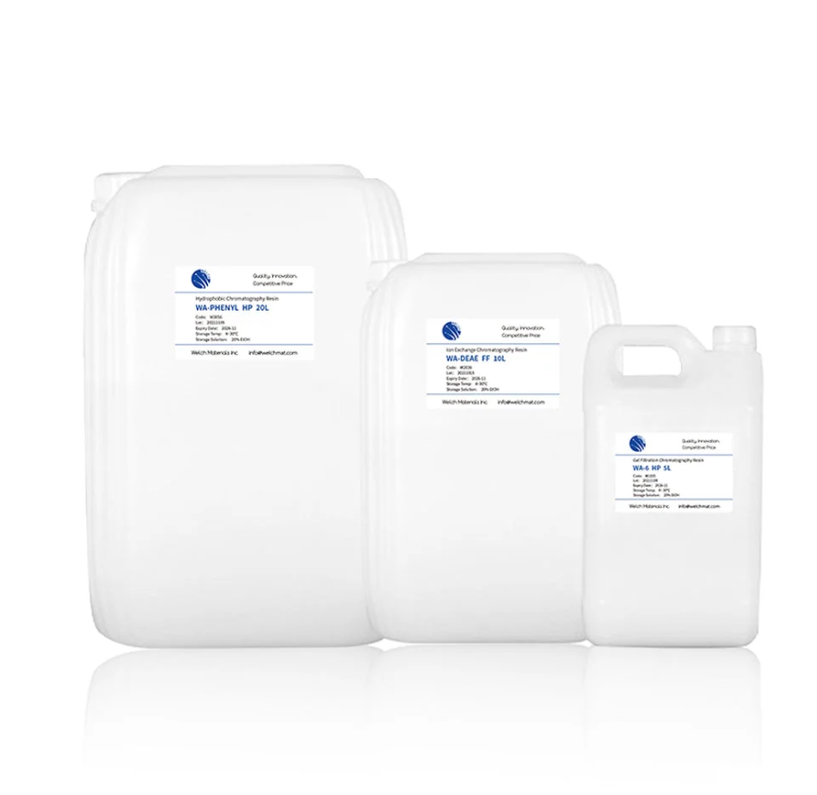
WA-4B, 200 mL
WA-4B, 200 mL
Agarose-based chromatography medium for the separation, purification and analysis of polysaccharides, nucleic acids, viruses and other large biomolecules.

Product Overview
WA-4B is an agarose-based chromatography medium made from 4% agarose. It is processed through emulsification, washing and sieving to produce a porous bead matrix suitable for gel filtration applications.
This medium is designed for the separation, purification and analysis of polysaccharides, nucleic acids, viruses and other large biomolecules. Its porous bead structure enables molecules to be separated according to differences in their size and shape.
The gel structure is stabilized by hydrogen bonding. As a result, the matrix is soft and has limited pressure resistance. WA-4B is not suitable for autoclaving.
Product Specifications
| Product Name | WA-4B |
| Catalog Number | 1686-W1001 |
| Pack Size | 200 mL |
| Material | Agarose |
| Agarose Concentration | 4% |
| Brand | WA |
| Separation Mode | Gel Filtration |
| Bead Structure | 4B |
| Dry Ice | No |
| Hazardous | No |
Applications of WA-4B Agarose
WA-4B is suitable for gel filtration applications involving the separation and purification of large biomolecules. Its stated application range includes:
- Separation and purification of polysaccharides.
- Analysis and purification of nucleic acids.
- Separation and analysis of viruses.
- Purification and analysis of other large biomolecules.
- Size-based separation of biomolecules in laboratory chromatography workflows.
Gel Filtration Chromatography (GFC)
Principles of Gel Filtration
Gel filtration chromatography (GFC), also known as size-exclusion chromatography, separates biomolecules according to differences in molecular size and shape. The chromatography medium consists of porous beads through which the sample passes.
Larger molecules are unable to enter most of the internal pores and therefore travel through the column more quickly. They generally elute near the void volume and have shorter retention times.
Smaller molecules can enter more of the bead pores. Their movement through the matrix is consequently delayed, resulting in longer retention times.
Effective separation depends on selecting a chromatography medium with suitable pore characteristics for the molecular sizes of the target substances.
Choosing Gel Filtration Media Based on Separation Purpose
1. Group Separation
Group separation classifies sample components into high and low molecular weight groups. This approach is commonly used for desalting and buffer exchange procedures.
Example: WD-G25 series.
2. Fine Separation
Fine separation is intended to resolve components with similar molecular weights. It is used in analytical chromatography and fine purification workflows.
Examples: WA-FF and WA-GF series.
Matrix Characteristics and Handling
WA-4B is a 4% agarose matrix whose gel structure is stabilized by hydrogen bonding. This produces a soft bead matrix with limited pressure resistance.
- Made from 4% agarose.
- Manufactured through emulsification, washing and sieving.
- Porous bead structure for gel filtration.
- Soft matrix with limited pressure resistance.
- Not suitable for autoclaving.
Follow the manufacturer's instructions for use and handling. Avoid autoclaving this medium.
Related Products
Explore other agarose-based chromatography media and WA product formats:
| Catalog | Product Name |
|---|---|
| W1011 | WA-CL 4B, 200mL |
| W1049 | WA-GF200, 200mL |
| W1006 | WA-6B, 200mL |
| W1021 | WA-4FF, 200mL |
| W1039 | WA-GF30, 200mL |
| W1027 | WA-6FF, 200mL |
| W1044 | WA-GF75, 200mL |
| W1016 | WA-CL 6B, 200mL |
| W1004 | WA-4B, 10L |
| W1003 | WA-4B, 5L |
Order WA-4B, 200 mL
CAT: 1686-W1001 | Size: 200 mL
For laboratory use. Refer to the manufacturer's instructions for use for additional handling and operating conditions.
Recent Posts
-
WA-4B, 200 mL
Agarose-Based Gel Filtration Medium WA-4B, 200 mL Agarose-based chromatography medium for the sepa …10th Nov 2026 -
VLP Vaccines
VACCINOLOGY • IMMUNOLOGY • BIOTECHNOLOGY VLP Vaccines: Structure, Immunological Mechanisms and App …9th Nov 2026 -
siRNA Negative Controls
MOLECULAR BIOLOGY • RNA INTERFERENCE • GENETICS siRNA Negative Controls: Principles, Mechanisms, E …6th Nov 2026