
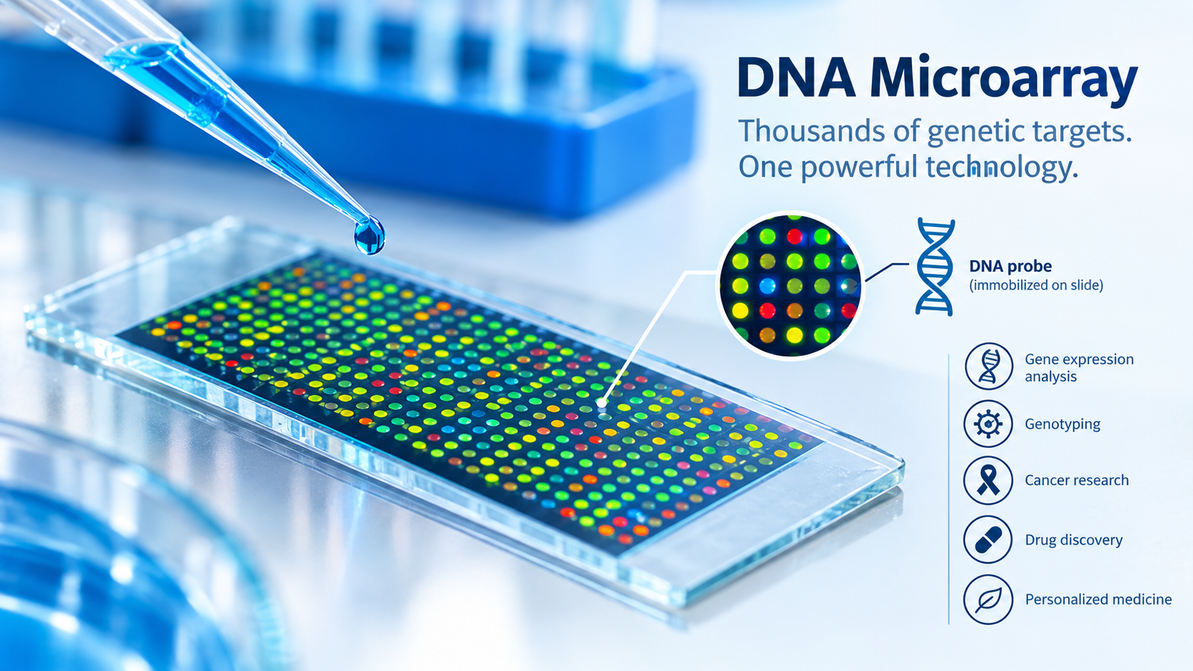
DNA Microarray Technology: How It Works and What It Is Used For
MOLECULAR BIOLOGY GUIDE
DNA Microarray Technology: How It Works and What It Is Used For
Discover how DNA microarrays work, their main types, applications in gene expression analysis, and differences from RNA sequencing.
DNA microarray technology is a high-throughput molecular biology technique that allows researchers to analyze thousands of predefined genetic targets simultaneously using DNA probes attached to a solid surface.
1. Introduction to Microarray Technology
Microarray technology is widely used in genomics and molecular biology to investigate gene expression, genetic variation, and biological processes. By analyzing many molecular targets in a single experiment, researchers can compare biological samples and identify changes associated with disease, drug treatment, or environmental conditions.
DNA microarrays are used in cancer research, drug discovery, molecular diagnostics, genetics, and personalized medicine. They provide a practical way to study thousands of known DNA or RNA sequences at the same time.
2. What Is a DNA Microarray?
A DNA microarray is a small solid surface, commonly made of glass or another suitable material, containing thousands of microscopic DNA probes arranged in a defined pattern. Each probe is designed to recognize a complementary nucleic acid sequence.
When a labeled DNA or RNA-derived sample binds to a matching probe, the interaction can be detected using a specialized scanner. The resulting signal provides information about the presence or relative abundance of the target sequence.
Unlike conventional methods that examine a limited number of targets at a time, microarrays support parallel analysis of thousands of predefined targets.
3. How Does DNA Microarray Technology Work?
A typical DNA microarray experiment involves five main steps.
Step 1: Sample Collection and Preparation
Researchers collect biological material, such as cells, tissue, blood, or microorganisms. DNA or RNA is extracted according to the experimental objective. In gene expression studies, RNA is commonly converted into complementary DNA (cDNA) before labeling.
Step 2: Hybridization
The prepared sample is applied to the microarray. Target molecules bind to complementary DNA probes through hybridization. The specificity of this interaction depends on sequence similarity and experimental conditions.
Step 3: Washing
The microarray is washed to remove unbound molecules and reduce nonspecific binding. Appropriate washing conditions help improve the quality and specificity of the detected signals.
Step 4: Signal Detection
A microarray scanner measures the signals generated by labeled molecules, often through fluorescence. The signal intensity at each probe location is recorded for further analysis.
Step 5: Data Analysis
Software converts scanned images into numerical measurements. Researchers normalize the data and apply statistical methods to identify differences in gene expression or genetic variation between samples.
4. Main Types of Microarrays
Gene Expression Microarrays
Gene expression microarrays measure the relative activity of thousands of genes. They are useful for comparing healthy and diseased tissues, examining cellular responses to treatments, and identifying genes associated with biological pathways.
DNA Genotyping Microarrays
Genotyping arrays detect known genetic variants, including single-nucleotide polymorphisms (SNPs). Applications include genetic association studies, population genetics, and the investigation of inherited variation.
Array Comparative Genomic Hybridization
Array comparative genomic hybridization (array-CGH) detects DNA copy-number gains and losses across the genome. It can help identify chromosomal imbalances associated with genetic disorders and cancer.
DNA Methylation Microarrays
Methylation microarrays examine DNA methylation at selected genomic regions. These epigenetic modifications can influence gene regulation without changing the underlying DNA sequence.
Protein Microarrays
Protein microarrays use immobilized proteins, antibodies, or other binding molecules to study protein interactions, immune responses, biomarkers, and protein function. Their experimental procedures differ from those used for DNA microarrays.
5. Applications of Microarray Technology
Cancer Research
Microarrays help researchers compare gene expression patterns in normal and cancerous tissues. These comparisons can reveal molecular signatures associated with tumor development, cancer subtypes, and responses to treatment.
Disease Research and Molecular Diagnostics
Microarrays can detect selected genetic variants and investigate molecular changes associated with disease. Clinical applications depend on the validation and intended use of the specific test.
Drug Discovery
Researchers use gene expression microarrays to examine how cells respond to candidate drugs. The results can provide insights into drug mechanisms, biological pathways, and potential toxicity-related effects.
Personalized Medicine
Genotyping arrays can identify selected genetic variants that may inform disease risk assessment or treatment decisions. Findings should be interpreted alongside clinical evidence and other relevant patient information.
Microbiology and Infectious Disease Research
Microarrays can detect selected microbial sequences and investigate host responses to infection. Researchers use them in pathogen studies, microbial classification, and investigations of host-microorganism interactions.
Agricultural and Environmental Research
Microarray technology can help scientists study plant gene expression, crop characteristics, stress responses, and selected environmental microorganisms. It provides insight into how biological systems respond to changing conditions.
6. Advantages of DNA Microarrays
- High-throughput analysis: Thousands of predefined genetic targets can be examined in one experiment.
- Efficient sample use: Many targets can be studied using a relatively small amount of biological material.
- Parallel measurements: Multiple genes or genetic variants can be analyzed simultaneously.
- Established workflows: Many platforms have standardized protocols and analysis tools.
- Comparative analysis: Researchers can identify differences between samples and experimental conditions.
7. Limitations of Microarray Technology
Despite their advantages, microarrays have several limitations. Most platforms detect only sequences represented by probes on the array, making them less suitable for discovering completely unknown sequences.
Cross-hybridization between similar sequences can affect specificity. Sample quality, labeling efficiency, hybridization conditions, batch effects, and data normalization can also influence results.
Microarrays therefore require appropriate experimental controls, biological replicates, and careful statistical analysis. Researchers should select the platform according to the biological question and the level of detail required.
8. Microarrays vs. RNA Sequencing
Microarrays and RNA sequencing (RNA-seq) are both used to study gene expression, but they rely on different principles.
| Feature | DNA Microarray | RNA Sequencing |
|---|---|---|
| Principle | Hybridization to predefined probes | Sequencing of RNA-derived fragments |
| Target coverage | Limited to represented probes | Can detect known and novel transcripts, subject to sequencing depth and analysis |
| Data output | Probe signal intensities | Sequence reads and computational expression estimates |
| Best suited for | Established targets and validated workflows | Broader transcriptome analysis and transcript discovery |
The best method depends on the research objective, available resources, sample type, and required analytical detail. Microarrays remain useful for targeted studies, while RNA-seq offers greater flexibility for transcript discovery.
9. Frequently Asked Questions About Microarrays
What is the main purpose of a DNA microarray?
A DNA microarray measures or detects many predefined DNA or RNA targets simultaneously, depending on the type of array and experimental design.
What is microarray hybridization?
Microarray hybridization is the process by which a DNA or RNA target binds to a complementary probe attached to the microarray surface.
Are microarrays used to study gene expression?
Yes. Gene expression microarrays measure the relative activity of many genes and help researchers compare biological samples and experimental conditions.
What is the difference between a microarray and PCR?
PCR amplifies specific DNA sequences, while microarrays detect many predefined targets through hybridization. The two techniques serve different purposes and can complement each other.
Are microarrays still used in modern research?
Yes. Microarrays remain useful for genotyping, gene expression analysis, DNA methylation studies, and other applications involving predefined targets.
10. Scientific References
- Schena M, Shalon D, Davis RW, Brown PO. Quantitative monitoring of gene expression patterns with a complementary DNA microarray. Science. 1995;270(5235):467–470. Read the scientific article.
- Lockhart DJ, Dong H, Byrne MC, et al. Expression monitoring by hybridization to high-density oligonucleotide arrays. Nature Biotechnology. 1996;14:1675–1680. Read the scientific article.
- Bumgarner R. DNA microarrays: Types, applications and their future. Current Protocols in Molecular Biology. 2013; Chapter 22: Unit 22.1. Read the scientific review.
Explore Molecular Biology Techniques
Discover more educational resources covering genomics, DNA analysis, gene expression, and molecular biology methods.
EXPLORE PRODUCTSRecent Posts
-
DNA Microarray Technology: How It Works and What It Is Used For
MOLECULAR BIOLOGY GUIDE DNA Microarray Technology: How It Works and What It Is Used For Discover h …26th Oct 2026 -
Types of PCR
MOLECULAR BIOLOGY GUIDE Types of PCR : Methods, Principles, and Applications Discover the different …23rd Oct 2026 -
DNA Analysis Using Analytical Gels
DNA Analysis Using Analytical Gels Principles, Methods, Interpretation, and Applications of Gel El …20th Oct 2026